

Transforming Civic Infrastructure for Resilience
How Sunnyvale is modernizing its civic campus to better serve residents while advancing sustainability and resilience.
Civic facilities are increasingly expected to do more than provide public services. They must support ambitious sustainability goals, remain operational during emergencies, and adapt to the changing needs of growing communities.
The City of Sunnyvale confronted those challenges through a long-term effort to transform its Civic Center. Home to City Hall, the Library, and Public Safety Headquarters, the campus had served the community for decades, but many of its buildings were aging and increasingly inefficient. At the same time, continued population growth in California was driving greater demand for City services and expanding operational needs.
To address those challenges, the City developed a Civic Center Master Plan that will guide the campus's modernization over several decades. The plan seeks to improve access to City services, enhance emergency preparedness, and create a more sustainable and resilient civic campus for the future.
Working alongside the City of Sunnyvale and SmithGroup, PAE provided mechanical, electrical, plumbing, and regenerative design services for Phase 1 of the Master Plan. Through extensive engagement with community members, City staff, and the Sustainability Commission, the project team established a set of priorities—including net zero energy, resilience, water stewardship, carbon reduction, and healthy buildings—that would shape the campus's future development.
Those priorities ultimately revealed an important connection: many of the strategies intended to reduce energy use and environmental impact also strengthened the campus's ability to maintain critical operations during emergencies.
Sustainability as a Civic Responsibility
The City set ambitious sustainability goals for the project, targeting both Net Zero Energy and LEED Platinum certification. Sunnyvale's REACH codes already encourage electrification and high-performance building design, and the Civic Center was intended to reflect those same priorities.
If achieved, the new City Hall would become the first city hall in the nation to earn both Net Zero Energy and LEED Platinum certification, setting a new benchmark for civic buildings.
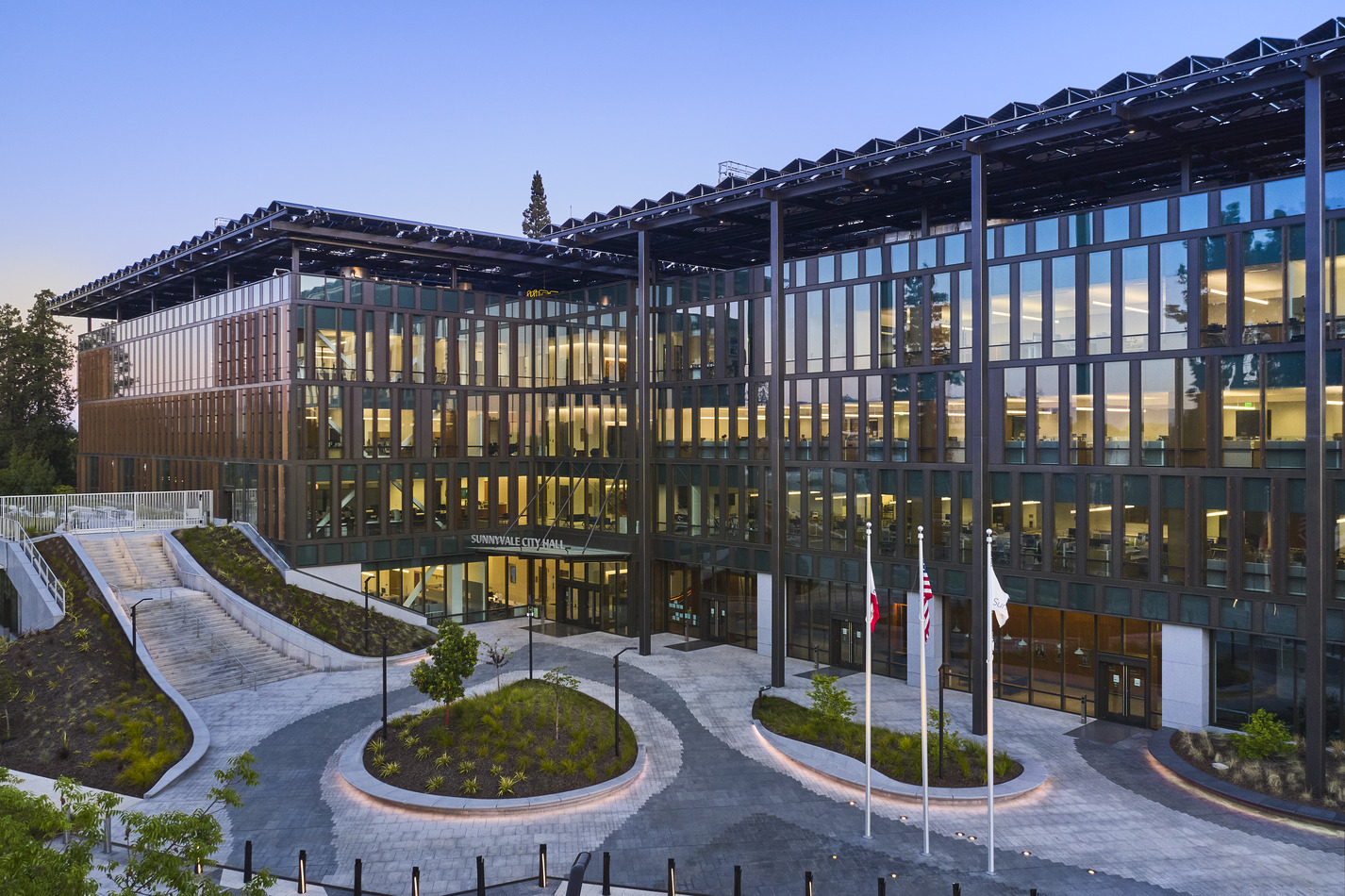
An all-electric design, combined with passive strategies, rooftop photovoltaics, and high-performance HVAC systems, helps reduce energy demand while supporting the City's Net Zero Energy goals. The strategy aims to generate as much renewable energy on-site as the campus consumes annually.
Water use was another key consideration. The project incorporates strategies to reduce potable water consumption, along with sustainable materials and indoor environmental quality measures that support occupant health and comfort.
While these measures were initially driven by sustainability objectives, they also laid the foundation for a broader conversation about resilience.
Resilience Beyond the Grid
Civic buildings must remain operational during emergencies, and the project's all-electric design added a new challenge: maintaining critical services during prolonged outages.
To address that challenge, the campus incorporates an integrated energy strategy that combines on-site solar generation, battery energy storage, backup generation, and microgrid controls. Together, these systems are designed to offset 100% of the campus's annual energy use through on-site renewable energy while reducing peak electrical demand by 73%.
As the project evolved, the battery energy storage system took on an expanded role. Initially envisioned as a tool to help achieve the project's Net Zero Energy and LEED Platinum goals, it also became a key component of the campus's resilience strategy, helping coordinate solar generation, energy storage, backup power, and building operations during outages.
Rather than relying solely on traditional backup power, the campus microgrid balances available energy resources in real time, prioritizing critical functions while reducing dependence on fuel-powered generation whenever possible.
Supporting Critical Operations
Resilience also informed the design of the Emergency Operations Center and renovated Public Safety Building, which were equipped with standalone MEP systems to help maintain critical operations even if other portions of the campus are disrupted.
As wildfire smoke events become more common across the western United States, maintaining healthy indoor environments has become an increasingly important aspect of resilience. Enhanced ventilation and air filtration strategies help protect building occupants during periods of poor outdoor air quality, allowing City operations to continue while supporting occupant health and well-being.
By integrating resilience into the design from the outset, the Civic Center is better prepared to support both everyday operations and emergencies. As future phases of the Master Plan move forward, the project demonstrates how civic infrastructure can evolve to meet the changing needs of a growing city.